The AI Integration Decision Framework: Buy, Build, or Wait
Dave Graham
Principal Consultant
January 6, 2026

Every business leader I talk to wants to "implement AI." Few can articulate what that actually means for their organization.
The result? Paralysis. Or expensive projects that solve problems nobody has.
The conversations all hit the same wall: too many options, unclear ROI, and no obvious starting point. So I built a framework to cut through it. You have three options: Buy existing tools, Build custom AI solutions, or Wait until you're ready. Here's how to know which is right for you.
When to BUY Existing AI Tools
Buy when the problem you're solving is common and tools exist that solve it well enough.
Buy makes sense when:
- The problem is widespread. If thousands of businesses have this problem, someone has probably built a solution.
- Tools exist with proven track records. Look for case studies, reviews, and companies similar to yours using the tool.
- Speed to value matters more than customization. A tool that's 80% right today beats a custom solution that's 100% right in six months.
- You lack technical capacity. Be honest about this. Building requires ongoing engineering investment.
Common "buy" categories (a market overview, not endorsements):
| Problem | Tool Category | Examples |
|---|---|---|
| Content creation | AI writing assistants | Jasper, Copy.ai, Your favorite LLM |
| Meeting documentation | AI summarizers | Fireflies, Jamie, Granola |
| Customer support | AI-powered helpdesks | Intercom Fin, Zendesk AI, Freshdesk Freddy |
| Document processing | AI extraction tools | Docsumo, ABBYY, Nanonets |
Evaluation criteria for AI tools:
- Integration fit. Does it connect to your existing stack without heavy custom work?
- Total cost. Subscription + implementation + training + ongoing management. The sticker price is rarely the real price.
- Data handling. Where does your data go? Who can access it? Can you delete it? Do you have granular control?
- Exit strategy. Can you export your data and workflows if you need to switch?
When to BUILD Custom AI Solutions
Build when off-the-shelf tools can't do what you need, and what you need is strategically important.
AI coding tools have collapsed the time and cost of building custom solutions. What used to require weeks of engineering can now be prototyped in hours. The old advice was "buy unless you absolutely must build." The new advice: prototype quickly, then decide.
Build makes sense when:
- Your process is genuinely unique. Not "we do things differently" unique. Actually unique. Most processes feel special but aren't.
- AI is a competitive differentiator. If AI will be core to your value proposition, owning the technology matters.
- You have capacity to maintain it. Building is 20% of the work. Maintaining and improving is 80%. No owner identified? Don't build.
- Data sensitivity requires control. Some industries demand data never leaves your infrastructure.
- You're not just chasing "innovation." If you can't calculate ROI or you're replicating what existing tools do well, buy instead.
When to WAIT
Waiting can be strategic patience. But it should be intentional, not default.
Wait makes sense when:
- Your processes aren't documented. AI can't automate chaos. If you don't know how work gets done today, you're not ready to change it.
- The underlying problem isn't clear. "We should use AI" isn't a problem statement. What specific outcome are you trying to achieve?
- The technology is too immature for your risk tolerance. Some AI applications are mature (document processing). Others are experimental (autonomous decision-making). Know the difference.
- You're chasing hype, not solving a problem. If you can't articulate the business case without using the word "AI," wait.
How to wait productively:
Don't just wait. Prepare:
- Document your current processes. Map workflows, identify bottlenecks, measure time spent.
- Build internal AI literacy. Get your team comfortable with AI tools through low-stakes experimentation.
- Set review triggers. "We'll revisit this when Tool X supports Feature Y" or "When we hit $X revenue."
- Watch the market. What are similar companies doing? What tools are emerging?
Waiting with a plan is strategy. Waiting without a plan is avoidance.
The Decision Matrix
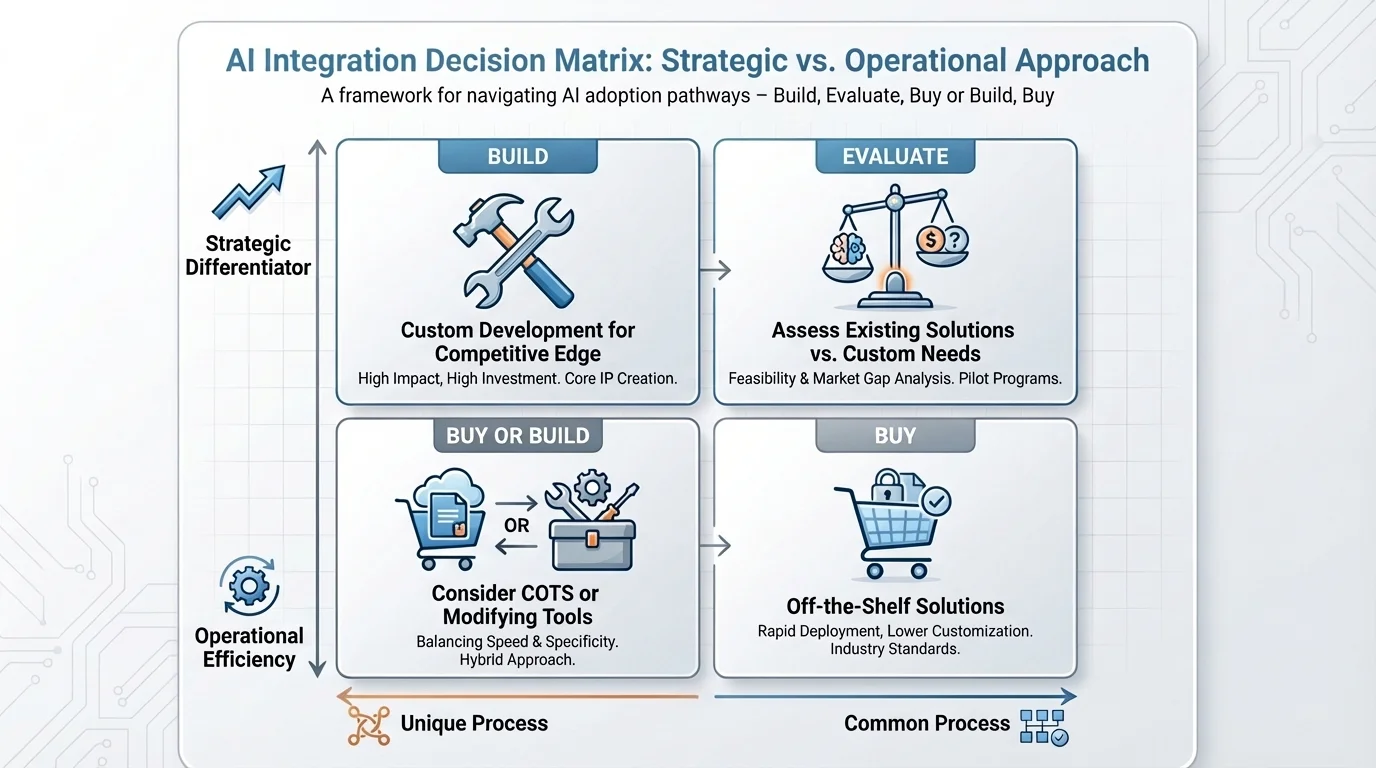
When clients ask me "build, buy, or wait?" I start with two questions:
- Is this process a differentiator or a cost center?
- Is the process unique to you or common across businesses?
Then I add the qualifier questions:
- Do tools exist that solve 80%+ of the problem?
- Do you have capacity to build AND maintain?
- What's the cost of waiting 6-12 months?
Most companies discover they should buy more than they think. The instinct to build custom is often ego ("we're special") rather than strategy.
Making the Call
The uncomfortable truth is that most AI integration decisions come down to organizational readiness, clear problem definition, and honest assessment of capabilities.
The companies that succeed with AI are the ones who:
- Know exactly what problem they're solving
- Honestly assess their capacity to build vs. maintain
- Choose the simplest solution that works
- Measure results and iterate
If you're struggling to decide between build, buy, or wait, you may be asking the wrong question. Start with: "What specific outcome do we need, and what's the simplest path to get there?"
Need help making this decision for your business? I offer free 30-minute strategy sessions. We'll look at your specific situation and identify where AI could actually help. No obligation, just a useful conversation.